

How to Create High-Quality Content with AI
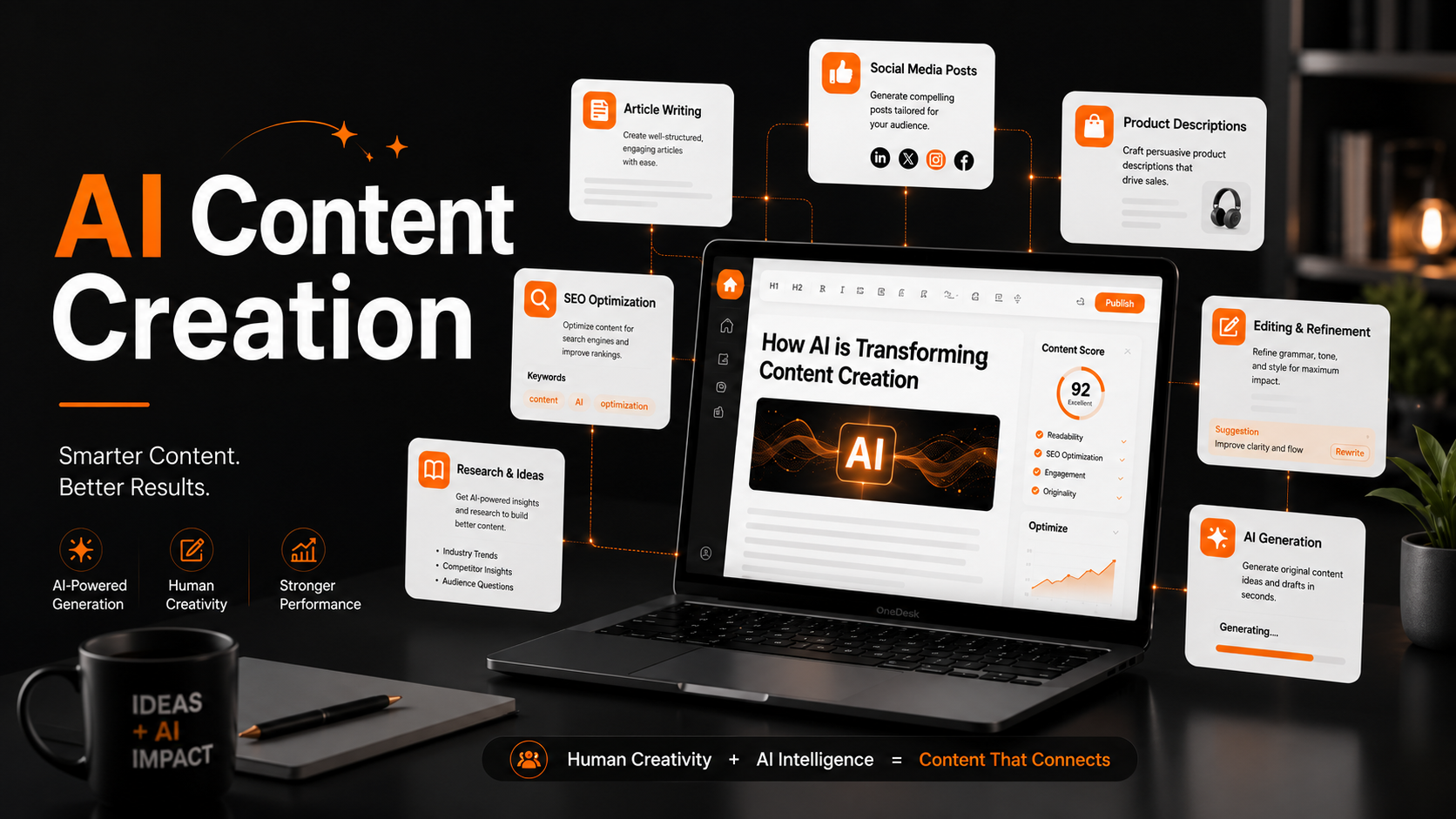
AI Content Creation is the use of artificial intelligence to generate, improve, adapt, or organize content such as articles, images, videos, advertisements, emails, and social media posts. It matters because it can help individuals and businesses complete parts of the creative process more efficiently. However, effective use requires more than entering a prompt and publishing the result. Human expertise, fact-checking, editing, and strategic direction remain essential for producing accurate, distinctive, and trustworthy content.
What Is AI Content Creation?
AI Content Creation refers to using artificial intelligence systems to assist with the production of digital content. These systems can generate new material from instructions, examples, uploaded documents, or other forms of context.
Most modern content tools rely on generative AI. Unlike traditional software that follows a fixed set of rules, generative AI identifies patterns in its training data and uses those patterns to produce an appropriate response to a prompt. It can create text, images, audio, video, software code, and other media.
AI may support one step of a project or an entire workflow. For example, a marketer might use it to brainstorm campaign themes, draft several headlines, rewrite text for different audiences, and prepare an initial publishing schedule.
The resulting material is usually described as AI-assisted content when people remain actively involved, or AI-generated content when most of the initial output comes directly from the system.
How AI Content Creation Works
AI content tools work by processing a user’s instructions and predicting an appropriate output based on learned patterns.
A typical workflow includes four stages:
1. Providing instructions
The user writes a prompt describing the subject, audience, format, purpose, tone, and relevant constraints. Detailed context usually produces more useful results than a vague request.
2. Generating an initial output
The AI system interprets the prompt and creates a response. Depending on the tool, this might be a blog outline, product image, video script, email, advertisement, or social media caption.
3. Refining the result
The user may ask the system to shorten the content, clarify a section, change the tone, add examples, reorganize ideas, or generate alternative versions.
4. Reviewing and publishing
A qualified person checks the output for accuracy, relevance, originality, brand alignment, legal concerns, and audience value before publication.
OpenAI describes writing tools as useful for drafting, revising, and refining content while maintaining attention to structure, tone, and intent.
Common Types of AI-Generated Content
AI can assist with many content formats, including:
- Blog posts, articles, summaries, and outlines
- Product descriptions and category pages
- Social media posts and content calendars
- Email campaigns and newsletters
- Advertising headlines and promotional copy
- Images, illustrations, and design concepts
- Video scripts, storyboards, captions, and voiceovers
- Reports, presentations, and internal documents
- Frequently asked questions and customer-support responses
The best format depends on the organization’s objectives. A retailer may prioritize product content, while a professional-services company may focus on educational articles, proposals, and lead-generation campaigns.
Benefits of AI Content Creation
The primary benefit is greater efficiency during repetitive, exploratory, or time-consuming parts of content production.
Faster first drafts
AI writing tools can quickly transform a brief into an outline or preliminary draft. The creator can then spend more time improving the argument, adding experience, interviewing experts, and checking facts.
More ideas and variations
A marketing team can use AI to explore multiple campaign angles, headlines, calls to action, or social media concepts. This helps teams move beyond the first idea without treating every suggestion as publishable.
Easier content adaptation
A long article can be adapted into an email, short post, presentation outline, or video script. AI can also adjust reading level, tone, length, and formatting for different audiences.
Better workflow support
Automated content production can reduce routine work such as organizing research notes, formatting information, creating metadata, or producing first-pass summaries.
IBM notes that marketing teams, designers, and writers can use generative AI for brainstorming and drafting, while also warning that governance and oversight are necessary.
Limitations and Risks
AI output may sound convincing even when it is incorrect, incomplete, outdated, or unsupported. Every important claim should therefore be verified against dependable sources.
Other risks include:
- Generic or repetitive writing
- Weak understanding of audience context
- Fabricated facts, quotations, studies, or references
- Unintended bias
- Inconsistent brand voice
- Confidentiality and data-security concerns
- Copyright, ownership, or licensing questions
- Large-scale production of low-value pages
Google does not prohibit content simply because AI helped create it. Its guidance instead emphasizes accuracy, quality, relevance, and value for users. Producing many pages primarily to manipulate rankings may violate Google’s policies on scaled content abuse.
Businesses should also avoid entering confidential client information, unpublished financial data, trade secrets, or sensitive personal information into tools unless the organization has approved the system and its data-handling terms.
How Humans and AI Can Work Together
Human-AI collaboration works best when AI handles acceleration and variation while people provide judgment, expertise, accountability, and creative direction.
Consider these realistic examples:
A small business drafting product descriptions
A furniture retailer uses AI to produce first drafts based on verified specifications such as dimensions, materials, colors, and care instructions. A staff member checks every detail, removes unsupported claims, and adds practical information based on real customer questions.
AI saves drafting time, but the human reviewer protects accuracy and ensures that each description is genuinely useful.
A marketing team developing social media ideas
A marketing team provides campaign goals, audience profiles, brand guidelines, and previous performance insights. The system suggests 20 post concepts and several headline variations.
The team rejects weak ideas, chooses those that support the campaign strategy, and rewrites them using the company’s authentic voice. AI expands the creative options; marketers make the final decisions.
A writer researching and editing an article
A writer uses AI to organize questions, build an outline, identify topics requiring further research, and review a draft for unclear sentences. The writer then consults original sources, interviews relevant experts, develops an independent argument, and verifies every important statement.
In this workflow, AI acts as an assistant rather than an uncredited source of authority.
Research into collaborative AI continues to explore how systems can better support production-quality creative work. Stanford researchers emphasize that generating an impressive result is not the same as collaborating effectively with a person.
Best Practices for Creating High-Quality AI-Assisted Content
Start with a clear purpose
Define the audience, user need, search intent, desired action, and publishing format before generating anything.
Give the AI reliable context
Provide approved facts, product specifications, brand guidelines, examples, tone requirements, and restrictions. Do not expect the system to infer important business details correctly.
Add original value
Include firsthand experience, expert commentary, original examples, useful comparisons, internal research, or practical instructions. Content should offer more than a reformatted version of information already available elsewhere.
Verify every material claim
Check names, dates, statistics, quotations, legal statements, medical information, technical instructions, and cited sources. Open the original reference rather than trusting a generated citation.
Edit for clarity and brand voice
Remove repetition, vague language, unsupported superlatives, and formulaic introductions. Make sure the finished work sounds appropriate for the organization and its audience.
Apply sound search engine optimization
Use descriptive headings, a clear page structure, helpful internal links, accurate metadata, natural terminology, and accessible images. SEO should improve understanding rather than force keywords into every paragraph.
Google recommends creating helpful, reliable, people-first content instead of material designed mainly to manipulate search visibility. Its newer guidance for generative search also confirms that established SEO fundamentals remain relevant to AI-powered search experiences.
Establish accountability
Assign a named editor or subject-matter reviewer. Organizations should document who approves content, which tools are permitted, what information may be entered, and when disclosure is appropriate.
The Future of AI Content Creation
The future will likely involve increasingly integrated, multimodal, and personalized workflows. One system may help a team move from research and planning to text, images, audio, video, distribution, and performance analysis.
AI tools may also become better at following brand rules, retrieving approved company information, maintaining context across projects, and adapting content for different channels. However, more capable automation will not eliminate the need for human responsibility.
As synthetic content becomes easier to produce, trusted expertise and original perspective may become more valuable—not less. Businesses that combine efficient technology with credible authorship, careful review, transparent processes, and real audience knowledge will be better positioned than those using AI simply to increase publishing volume.
AI Content Creation should therefore be treated as a disciplined collaboration. The technology can accelerate production, but people must determine what is accurate, useful, responsible, and worth publishing.
Related Tags:

Discover Limitless Possibilities Today!
Feel free to use this as a starting point and adjust the language to better suit your specific context or messaging.